IFB Hamburg - Krebsdiagnostik mit Hilfe von KI

October 13, 2020
Das Hamburger Startup Mindpeak unterstützt Pathologen bei der Krebsdiagnostik: Die mikroskopische Auszählung der Krebszellen erfolgt bei der von Mindpeak entwickelten Anwendung durch Künstliche Intelligenz. Die IFB Hamburg hat das Startup gleich über mehrere Programme gefördert. Darüber hinaus konnte sich Mindpeak die EU-Förderung des EIC Accelerators sichern, die nur wenigen Projekten gewährt wird.

Etwa 500.000 Menschen erkranken jährlich in Deutschland an Krebs und es ist aus medizinischer Sicht zu erwarten, dass diese Zahl in den nächsten Jahren aufgrund der längeren Lebenserwartung steigen wird. Der Behandlungserfolg hängt maßgeblich vom Zeitpunkt der Entdeckung ab: Je früher und besser die Krankheit erkannt wird, umso höher sind die Heilungschancen. „Bislang mussten Pathologen im Labor die Gewebeproben wie vor 100 Jahren mit bloßem Auge unter dem Mikroskop analysieren – eine oftmals zeitintensive und teils auch ermüdende Arbeit“, so Felix Faber, Gründer und CEO von Mindpeak. Das Hamburger Startup möchte dies ändern und setzt deshalb seine Erfahrung im Bereich Künstliche Intelligenz für die Krebsdiagnostik ein.

Wie KI bei der Krebsdiagnose unterstützen kann

Bei der von Mindpeak entwickelten Anwendung „BreastIHC“ handelt es sich um einen Deep-Learning-Algorithmus, der schnell und insbesondere auch zuverlässig Brustkrebszellen identifizieren kann. Ein großer Vorteil von Mindpeak ist der Zugang zu Daten. „Wir arbeiten mit sieben Partnerlaboren, unter anderem von der Berliner Charité, zusammen und haben so Zugriff auf über 20 Millionen Objektträger. Das ist die entscheidende Basis für den Einsatz von Künstlicher Intelligenz, denn diese muss mit großen Datenmengen „gefüttert“ werden, um ihre Stärke - die Erkennung von Mustern - ausspielen zu können“, erläutert Faber. Auch sollte der Algorithmus hinter „BreastIHC“ in der Lage sein, unter schwierigen Bedingungen, beispielsweise bei nicht ganz sauber eingefärbten Proben, ein korrektes Ergebnis zu liefern. „Unser Algorithmus hat in einer Vielzahl an Tests bewiesen, dass er auch sehr stabil unter nicht optimalen Bedingungen läuft und daher vielseitig einsetzbar ist. Dass wir nun erste Lizenzen verkauft haben, bestätigt unseren Weg“, sagt Faber.

Mindpeak – eine Erfolgsgeschichte

Mindpeak wurde 2018 in Hamburg von Felix Faber und Dr. Tobias Lang gegründet. Während Felix Faber Erfahrungen im Bereich Unternehmensgründung (bis hin zum Börsengang) mitbringt, ist Dr. Tobias Lang Experte im Bereich Machine Learning und hat unter anderem ein Deep-Learning-System für Zalando entwickelt. „Wir haben uns gefragt: Was kann Künstliche Intelligenz leisten, um der Gesellschaft einen Mehrwert zu bieten? Bei der Krebsdiagnostik bedeutet Schnelligkeit im Zweifel Lebenszeit“, so Faber. „Unsere Mission ist es, Krebsdiagnostik mittels Künstlicher Intelligenz für alle Menschen schnell und kostengünstig verfügbar zu machen.“

Mittlerweile hat Mindpeak 25 Mitarbeiter, die sich um die (Weiter)Entwicklung und Expansion kümmern. „Talente im Bereich Künstliche Intelligenz sind sehr gefragt. Viele Mitarbeiter in diesem Bereich entscheiden sich für uns, da Krebs bekämpfen einfach erfüllender ist als bei Google Werbung zu optimieren“, sagt Faber.

Zahlreiche Förderer unterstützen Mindpeak

Aber nicht nur Mitarbeiter konnte das junge Unternehmen von sich überzeugen, sondern auch Förderer. Die IFB Hamburg hat Mindpeak gleich mit mehreren Förderprogrammen unterstützt: Über die Tochtergesellschaft IFB Innovationsstarter GmbH wurde mit Zuschüssen aus dem Programm InnoRampUp die automatische Quantifizierung von Krebszellen im Brustgewebe mit Deep Learning ermöglicht. Außerdem beteiligte sich der Innovationsstarter Fonds in Höhe von 600.000 Euro an Mindpeak. Das Fondsvolumen wird zu gleichen Teilen von der Freien und Hansestadt Hamburg und dem Europäischen Fonds für Regionale Entwicklung (EFRE) bereitgestellt. „Die Beteiligung des Innovationsstarter Fonds haben wir für die Weiter- und Neuentwicklung unserer Krebserkennung für verschiedene Organe genutzt“, freut sich Faber.

Die jüngste Förderung über die IFB Hamburg erfolgte im Sommer 2020 über das Programm PROFI Transfer in Höhe von 600.000 Euro. Darüber hinaus ist Mindpeak das erste Hamburger Unternehmen, das die kombinierte EIC-Accelerator-Förderung der EU erhält, die nur wenige, herausragende Unternehmen in Europa bekommen: Die EU unterstützt die Expansion Mindpeaks ins europäische und US-amerikanische Ausland seit August 2020 sowohl mit einem Zuschuss von rund 1,4 Millionen Euro als auch mit europäischem Beteiligungskapital in Höhe von 1 Million Euro.

Neben öffentlichen Förderern haben sich auch private Business Angels und Venture Capital Unternehmen an Mindpeak beteiligt. „Die große Zahl an Förderern von Mindpeak ist in dem äußerst spannenden Business Case begründet. Der Bereich der Krebsdiagnostik ist bislang noch wenig bis gar nicht digitalisiert, "BreastIHC“ sehr innovativ. Die große Einsatzmöglichkeit, auch für viele weitere Krebsarten, ermöglicht eine hohe Skalierbarkeit des Produkts“, erläutert Gencer Sahin, Investment Manager bei der IFB Innovationsstarter GmbH das Engagement der Förderbank-Tochter. Sibyl Scharrer, Förderlotsin der IFB Hamburg für EU-Mittel, ergänzt: "Mindpeak ist ein gutes Beispiel dafür, dass sich das Bemühen um EU-Fördermittel lohnen kann - insbesondere, wenn das Geschäftsmodell eine Expansion ins Ausland erlaubt.“

Read the full article here.

In the News

Related reading

In the News
8 min read

Redefining HER2-ultralow Detection: Mindpeak & AstraZeneca at ASCO 2025

Mindpeak GmbH is looking back at an unforgettable experience at this year’s ASCO2025!

Seeing our work presented in front of 2,000+ experts on the world’s leading oncology stage was more than an honor - it was a defining moment in Mindpeak’s mission to transform cancer diagnostics with AI.

This year stood out as we reached key milestones - most notably, unveiling the transformative results of our collaboration with AstraZeneca, driving the evolution of breast cancer therapies.

Key Highlights:

AI-powered HER2-ultralow detection: Our technology, deployed in one of the world’s largest clinical studies, enabled HER2-ultralow detection at scale - supporting AstraZeneca's Enhertu clinical program.

Clinical Impact: As seen in our session, our AI was instrumental in generating reproducible, high-quality data that contributes to more personalized treatment strategies for breast cancer patients.

Digital pathology at center stage: With our tech featured across multiple sessions and posters, Mindpeak's vision of accessible, automated cancer diagnostics is becoming a reality.

#ASCO2025 wasn't just about showcasing innovation - it was about proving real-world impact.

We’re building AI that scales, adapts, and empowers clinicians worldwide. The response we received confirmed: we’re solving the right problems, in the right way.

A heartfelt thank you to our partners at AstraZeneca, to the many labs and clinicians who made this possible, and to the incredible team at Mindpeak. Your dedication and ambition are the heartbeat of this movement.

Let’s keep pushing forward - the future of AI-driven cancer care is happening now.

In the News
8 min read

AI-Supported Pathology Training Presented at ASCO 2025 in Collaboration with AstraZeneca

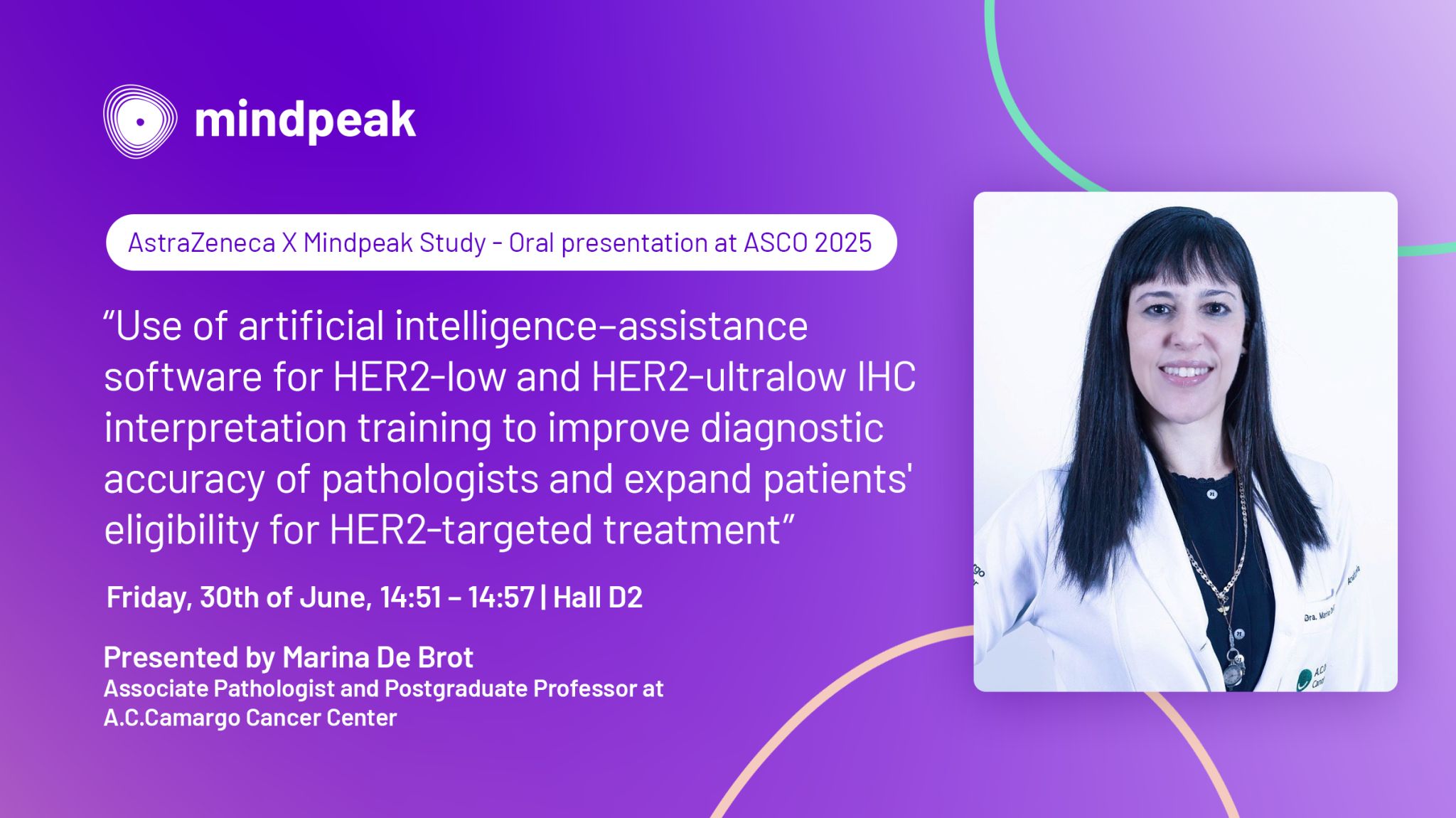
We were proud to present our collaborative research with AstraZeneca at the 2025 American Society of Clinical Oncology (ASCO) Annual Meeting. The study, focusing on AI-assisted training for HER2 IHC interpretation, was delivered by Marina De Brot on Friday, May 30th, in Hall D2, in Front of over 2000 people.

Enhancing Diagnostic Accuracy in HER2-Low and HER2-Ultralow Breast Cancer

The classification of HER2-low—and the emerging HER2-ultralow category - has become increasingly significant with the advent of HER2-targeted antibody-drug conjugates such as Enhertu. These therapies are providing new treatment options for patients with minimal HER2 expression, underscoring the importance of accurate diagnostic interpretation.

However, differentiating IHC 1+ from IHC 0, particularly in cases of faint membrane staining, remains a major diagnostic challenge. In line with the 2025 ASCO Annual Meeting theme introduced by ASCO President Dr. Robin Zon, our work aims to improve diagnostic precision and expand equitable access to personalized cancer treatments.

Global AI-Enabled Training Initiative

To address this challenge, we deployed an AI-supported training program through the Mindpeak GmbH ComPath Academy. The initiative engaged 287 pathologists across 11 countries, providing standardized education and decision support on HER2 IHC scoring.

Impactful Results for Clinical Practice

The study results were both clinically and statistically significant. Notably, the AI-supported training led to a 40% increase in accurate identification of HER2-ultralow cases—potentially expanding access to life-extending targeted therapies for a broader group of patients.

As highlighted in coverage by OncLive following the official ASCO press conference, this research reflects the evolving standards in cancer care. Accurate identification of HER2-low and HER2-ultralow patients is now a critical component of therapeutic decision-making in both metastatic and early-stage breast cancer settings.

Empowering, Not Replacing, Pathologists

This initiative is not about replacing pathologists with AI - it’s about empowering them. By combining expert training with advanced AI tools, we aim to improve diagnostic consistency and ensure that more patients receive the therapies they need.

We extend our thanks to everyone who joined us at ASCO 2025 and look forward to continuing our work toward a more precise, equitable future in cancer diagnostics.

In the News
8 min read

Continuing the Story: AstraZeneca and Mindpeak GmbH present new real-world results on AI-assisted HER2 scoring at ASCO 2025

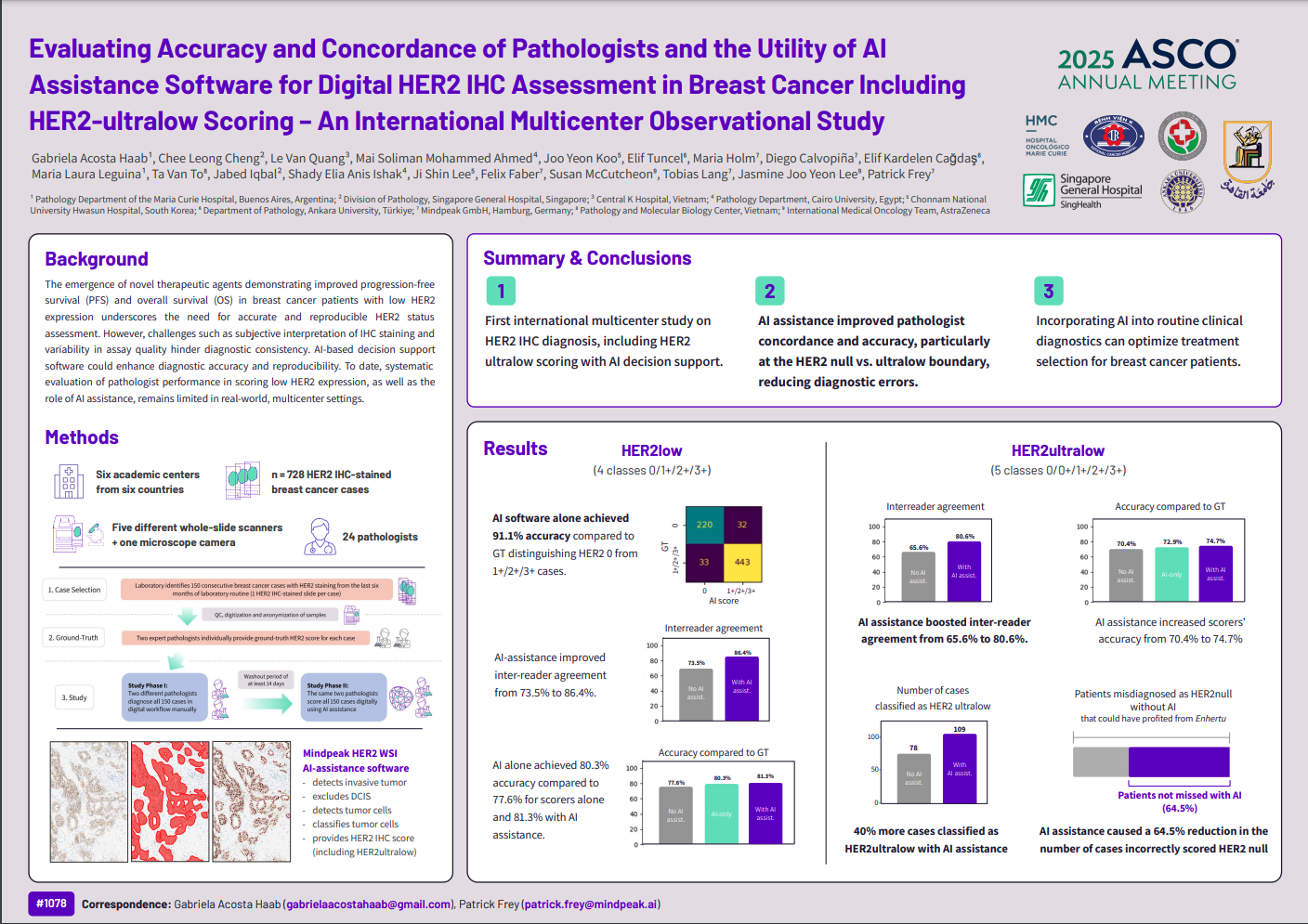
Continuing the Story: AstraZeneca and Mindpeak GmbH present new real-world results on AI-assisted HER2 scoring at ASCO 2025Following our oral presentation last Friday on the AI-assisted training for HER2 IHC interpretation, we are proud to share insights on the Monday’s poster session that took place at this year American Society of Clinical Oncology (ASCO) Annual Meeting.This time, it’s about  real-world diagnostics. In collaboration with six academic centers across the globe, we evaluated whether AI can truly enhance accuracy and consistency in daily pathology practice.And the answer is clear:AI support boosted diagnostic agreement  among pathologists to 86.4% for HER2-low and by 15% to 80.6% for HER2-ultralow - a major leap in consensus for some of the most challenging scoring decisions.Misclassification of HER2-null cases dropped by 64.5%, meaning more patients who may benefit from novel therapies like Enhertu can now be correctly identified.Accuracy rose across the board, especially in the critical 0 vs. 1+ distinction - an area long known for variability and clinical impact.Together, the oral and poster presentations offer a comprehensive view of how AI can support reproducible, high-quality HER2 assessment at scale - from training to clinical practice.As the clinical importance of HER2-low and ultralow scoring continues to grow, our findings provide strong evidence that AI can play a pivotal role in expanding access to targeted therapies like Enhertu - by enabling greater diagnostic precision.

Ready to advance your diagnostics

Connect with our team to explore how precision pathology works in your setting